
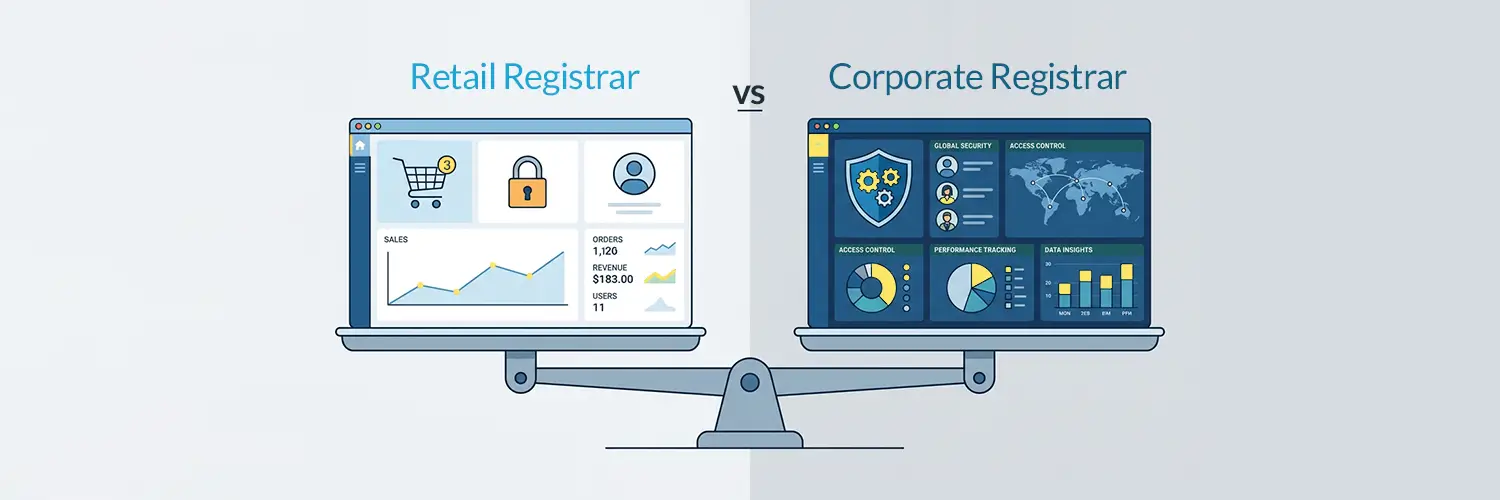
When establishing your business online, registering a domain name is step one. But as an organization scales, managing a digital footprint shifts from a basic administrative task into a complex infrastructure and security operation. This is usually the moment company leadership realizes that the platform they used to buy their very first .com might not be equipped to handle an enterprise-level ecosystem.
In the domain industry, registrars generally fall into two camps: retail and corporate. Understanding what each brings to the table can mean the difference between smooth global expansion and a devastating brand security failure.
The retail registrar: Designed for simplicity
Retail registrars are the household names you see advertised on tv. They are tailored primarily for individual creators, freelancers, and small businesses needing a handful of web addresses.
When dealing with a retail provider, you can expect a highly automated, self-service model. If an issue arises, support is usually routed through standard ticketing systems, community forums, or automated chatbots. Security features are generally basic, and the user interface is often cluttered with aggressive upselling for ancillary products like shared web hosting or generic site builders. While retail registrars are budget-friendly and excellent for starting out, they lack the sophisticated tools required to securely manage bulk portfolios, handle complex international registry requirements, or proactively protect a trademark from bad actors.
The corporate registrar: Built for enterprise brand protection
On the other end of the spectrum are corporate registrars. These specialized platforms are built from the ground up for enterprises, legal teams, and corporations that manage extensive, high-value domain portfolios.
At a corporate registrar, you can expect white-glove service focused heavily on corporate compliance, advanced security, and risk mitigation. Corporate registrars provide critical safeguards like Registry Lock, Single Sign-On (SSO) integration, and multi-user access controls to prevent unauthorized DNS modifications or accidental expirations. They also specialize in defensive domain strategies and continuous monitoring to detect phishing or trademark infringement. However, the downside to traditional legacy corporate registrars is that they often come with opaque pricing structures and restrictive, long-term contracts that lock you in.
The 101domain difference: Everything above, plus what legacy vendors can’t offer
This is where 101domain changes the game. We believe organizations shouldn’t have to choose between the agility of a retail platform and the deep security controls of a traditional corporate vendor. We bridge that gap.
Start with the baseline. Every corporate-grade safeguard described above is standard at 101domain. Registry Lock, Single Sign-On integration, granular multi-user access controls, defensive registration strategy, and continuous monitoring for phishing and trademark infringement. Add the compliance and risk mitigation work that comes with managing a high-value portfolio across dozens of registries. That is our floor, not our differentiator.
Here is what you get on top of it.
Transparent, predictable pricing. Unlike legacy corporate providers, we publish what things cost. No opaque fee structures, and no restrictive long-term contracts designed to keep you from leaving.
A dedicated Account Executive. A real human expert who knows your specific portfolio, monitors your brand liabilities, and can take immediate action when an emergency strikes.
The largest global domain selection anywhere. More than 1,800 domain extensions across over 200 countries and jurisdictions, including the country code domains with local presence, trustee, and documentation requirements that most providers won’t handle.
Programmatic control for your technical teams. Our recent rollout of the 101domain API and MCP Server lets your IT team pull domain data directly into existing technical workflows and AI agents, instead of exporting spreadsheets from a portal.
Managed security services. Cloudflare Enterprise, Red Sift OnDMARC, and Attack Surface Monitoring, managed alongside your portfolio by the same team that holds your domain names rather than bolted on from a separate vendor.
The result is a corporate registrar without the legacy tradeoffs. You keep the security posture your legal and IT teams require, and you get the pricing clarity, global reach, and technical flexibility they have historically had to give up to get it.
At 101domain, we don’t just register your names, we protect your entire digital presence. Whether you are navigating complex international expansions or implementing zero-trust security, 101domain gives you the corporate power you need with the flexibility you deserve.