
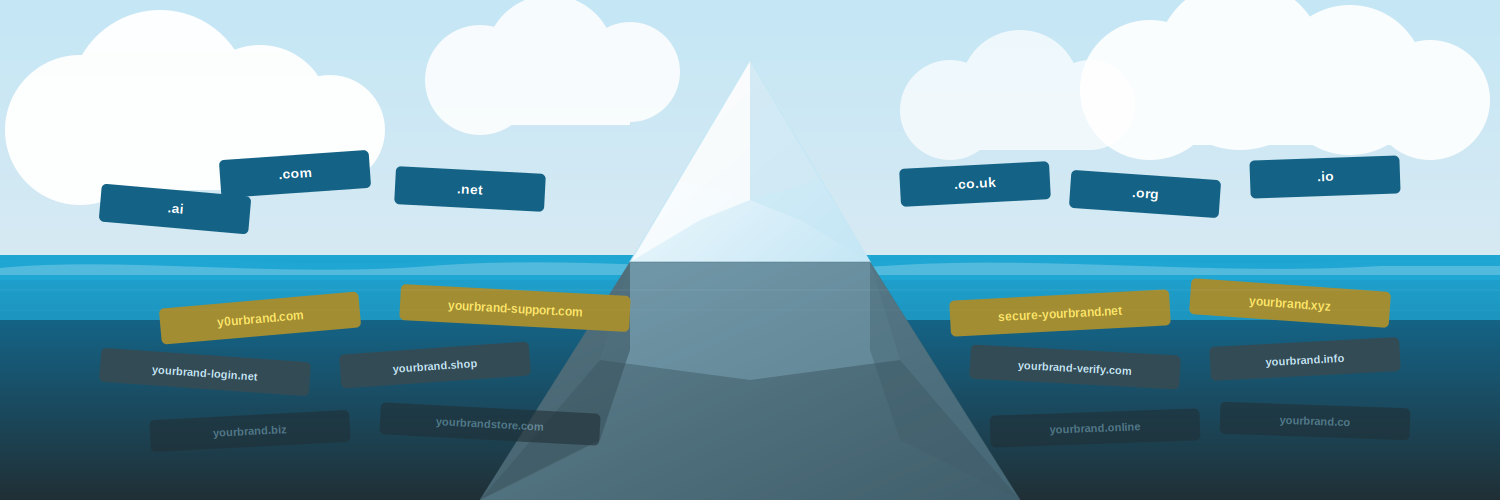
Your brand has two domain portfolios. One you manage and one you don’t — and it’s growing without your knowledge. Trademark squatters, lookalike phishing domains, and expired assets snapped up by bad actors form a “shadow portfolio” that actively works against you. It erodes customer trust, exposes employees to fraud, and creates brand liability — all before your team even knows the threat exists.
The uncomfortable truth? Most organizations don’t discover these threats through proactive monitoring. They discover them through a customer complaint, a security incident, or a letter from legal. By then, the damage is already done. This is the gap between reactive and proactive brand protection, and it’s wider than most enterprises realize.
You can’t protect what you can’t see
The first step toward meaningful brand protection is acknowledging that the problem is almost certainly larger than your current visibility allows. Trademark abuse, counterfeiting, and brand impersonation can easily go unnoticed. Fraudsters commonly register domains that look like yours and build convincing fake websites.
The domain names could contain a transposed letter, a different top-level domain, or your brand name with a word or phrase like “support” appended. Your customers land on it. Your employees get phishing emails from it. Your brand takes the reputational hit.
The hard reality: Just because you don’t see it doesn’t mean it isn’t happening.
Recent industry data makes domain name abuse a brand liability that’s impossible to ignore. Reported phishing attacks have surged over 180% since 2021, with nearly two million attacks recorded in the most recent annual period. Domain names were identified as the primary infrastructure that criminals exploit, according to Interisle Consulting Group’s Phishing Landscape 2025.
Meanwhile, new generic TLDs now account for 51% of all phishing domains reported, up from just 21% in 2021, making domain-based abuse the fastest-growing attack surface for brand impersonation.
It’s tempting to point to social media as the more visible threat. Social platforms are increasingly used for fake profiles, scam ads, and brand impersonation. But social media is the lure, not the trap. When a fraudster runs a convincing fake ad on Instagram or LinkedIn, they drive victims to a malicious domain designed to harvest credentials or payments. The domain is where the damage actually happens, and it’s where your organization has the most direct ability to intervene.
The hidden cost of an unmanaged portfolio
Most teams think about domain management as an IT overhead item. That framing underestimates the risk. Consider the math: a domain registration costs $10–$15. A counterfeit site built on a lookalike domain can generate millions in diverted revenue, cost hundreds of thousands in legal fees, and inflict brand damage that takes years to repair. A phishing campaign launched from an expired domain you once owned can compromise customer accounts, trigger regulatory scrutiny, and expose you to brand liability.
The risk isn’t in the domains you manage. It’s in the ones you’ve overlooked or let expire, and in the gap between when a threat emerges and when you find out about it.
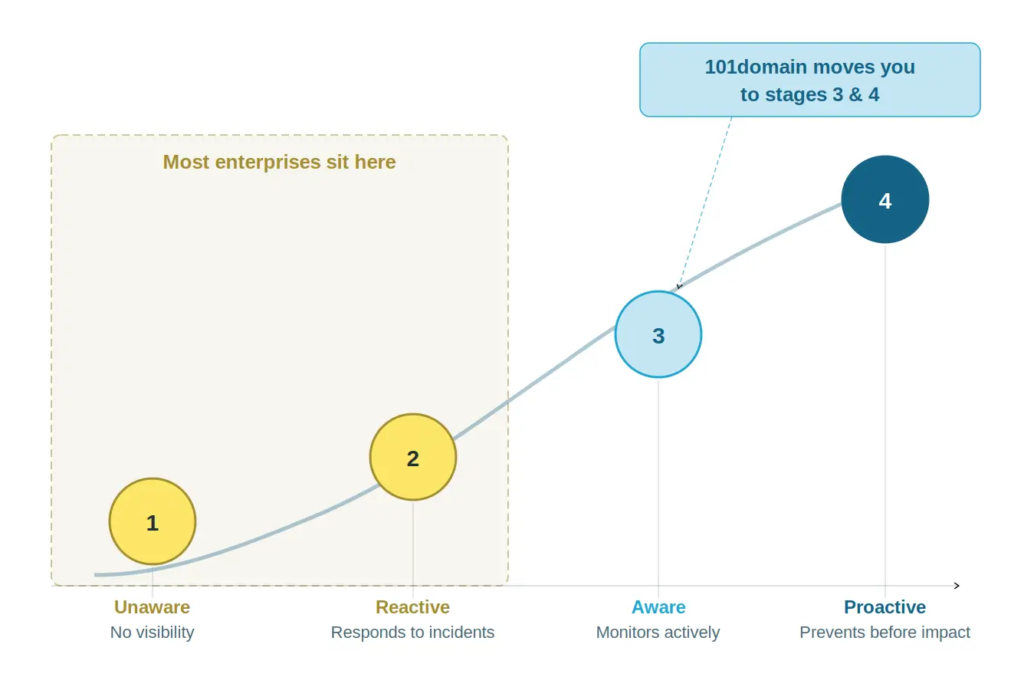
The brand maturity gap: Most enterprises sit between Unaware and Reactive on the brand protection curve. The jump to Proactive isn’t just a security upgrade — it’s a financial risk decision.
Organizations that treat domain portfolio management as a strategic function (not an administrative task) consistently outperform their peers on IP protection outcomes. The investment is modest. The exposure of not investing is not.
From reactive to proactive: A five-step path forward
Moving up the maturity curve doesn’t require an entire transformation. It requires a structured approach, the right tools, and a partner who can operationalize it. Here’s the progression:
Step 1 — Centralize and audit your domain inventory
Identify every domain your organization owns, map the gaps in your portfolio (the logical variations you should own but don’t), and establish expiration management so nothing slips through the cracks.
101domain’s Corporate Brand Services begins here, with a structured portfolio review that surfaces blind spots before bad actors can exploit them.
Step 2 — Take action against identified threats
Once you have visibility, you need an enforcement capability. This means coordinated domain disputes (UDRP, URS), takedown procedures, and legal workflows that can move quickly when a threat is identified.
You could pay lawyers and legal teams an hourly rate and retainer, or explore 101domain’s Enforcement Services. With decades of experience in online IP proceedings, we know which route will yield the best outcome, and we charge a one-time fee, saving you billable hours.
Step 3 — Shift from reactive to continuous monitoring
Proactive brand protection means continuously monitoring for lookalike registrations, brand abuse patterns, and malicious domain activity — and responding within hours, not weeks.
101domain’s Monitoring capabilities extend far beyond domains into trademarks, web pages, social media, marketplaces, and more, with flexible options for self-service or managed monitoring.
Step 4 — Enforce foundational security on every domain you own
Registry lock, DNSSEC, and SSO/2FA are the minimum security foundations for enterprise domain portfolios. These controls prevent unauthorized transfers, DNS hijacking, and credential-based account takeovers (the type of attacks that turn domain neglect into a crisis).
Step 5 — Run quarterly portfolio reviews
Brand protection isn’t a one-time project. Quarterly business reviews (supported by 101domain’s API integrations and your dedicated account executive) keep your portfolio clean, your access controls current, and your exposure window as narrow as possible.
Why 101domain for corporate brand services
Unlike retail registrars designed for individuals, 101domain’s corporate platform combines enterprise-grade security controls with a managed services model. That includes a dedicated account executive, solutions engineers, a customer success team, and domain support specialists (real people who know your specific portfolio and can advise and act quickly when it matters).
Our Corporate Brand Services offering covers the full protection lifecycle:
• Portfolio audit and gap analysis
• Defensive domain registration strategy
• Continuous monitoring for lookalike and infringing domains
• Coordinated takedowns and domain dispute services
• Registry lock, DNSSEC, and SSO/2FA enforcement
• Quarterly hygiene reviews with API-powered portfolio management
We’re not just a registrar. We’re a brand protection partner.
Start with a portfolio audit
The fastest way to understand your brand liability is to see it. 101domain’s domain availability report surfaces the shadow portfolio your team doesn’t know exists. This comprehensive audit is a starting point to help you reach your baseline.
Contact your 101domain account executive, or reach out to our Corporate Brand Services team to get started.

We are renowned for our global reach and capabilities—get the services and support you need to make meaningful decisions to ensure your brand is always protected.
Monitoring & Enforcement Services
Our monitoring solutions and dedicated analysts work around the clock for you. When a problem is found, we have solutions available to take care of it in-house.

Our Security & Technology Partners
As a security-focused domain name and web technology provider, we have a wide range of complementary services and best-in-class partners available to you when you need them.