
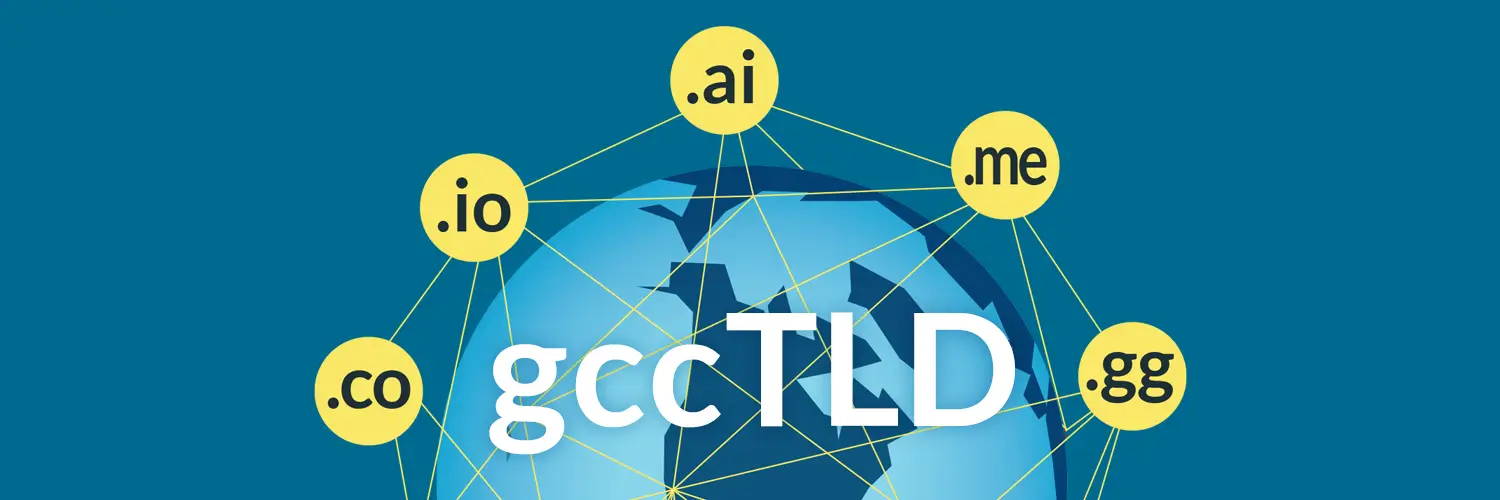
You’re browsing for a new domain name. You want something short, punchy, and memorable. You look at .com, but everything good was taken in 1998. Then you see them: .me, .tv, .gg, and the current heavyweight champion, .ai.
These are technically ccTLDs, Country Code Top-Level Domains originally created for specific regions.
You might think, “Wait, if .ai is the country code for Anguilla, will Google only show my site to people on a tiny Caribbean island?”
The answer is “No,” and that is all thanks to a special designation called a gccTLD.
What makes a gccTLD?
Most country code domains (ccTLDs) are “territorial.” If you use a .ca domain, Google assumes your content is for Canadians. If you use .fr, you’re talking to France.
But every once in a while, a country code becomes so popular globally that the lines get blurred. When people started using .tv for video sites instead of just websites in the island nation of Tuvalu, Google took notice.
Google created a “Generic” category for these country codes; hence, g-ccTLD (Generic Country Code Top-Level Domain). It’s essentially Google saying, “We recognize that even though this domain technically belongs to a country, the world is using it as a general-purpose extension.”
What does this mean for your SEO?
Normally, a country code domain is stuck with “geotargeting.” Google tries to match the domain to the local audience.
However, with a gccTLD, Google Search Console stops geotargeting your website. Instead of being anchored to one specific country, your site is treated as location-independent. It has the same global ranking potential as a .com or .org. You get the benefit of a cool, short country code without the penalty of being hidden from the rest of the world.
How to use these domains to your advantage
If you’re tired of fighting for scraps in the .com world, gccTLDs are your secret weapon. Here’s why savvy searchers love them:
1. The “Domain Hack” Since many of these are two letters, they are perfect for wordplay. Think help.me, find.it, or record.it. It’s a great way to bake a call-to-action right into your URL.
2. Better Availability Let’s be honest: the .com neighborhood is crowded. Finding a five-letter dictionary word there is nearly impossible. In the gccTLD space, there is still plenty of “prime real estate” available for a reasonable price.
3. Instant Industry Identity Some gccTLDs have become shorthand for specific niches. If you see a .gg domain, you immediately think “gaming.” If you see .ai, you know there’s some machine learning magic under the hood. It’s instant branding before the page even loads.
The Heavy Hitters: Examples you’ve seen everywhere
You’ve probably been visiting gccTLDs for years without realizing they were technically “country” domains:
- .tv (Tuvalu): The gold standard for streaming and video platforms (thanks, Twitch).
- .gg (Guernsey): Short for “Good Game,” it has become the home for esports and gaming communities.
- .me (Montenegro): The ultimate choice for personal blogs, portfolios, and “About Me” pages.
- .ai (Anguilla): Currently the hottest extension on the planet for tech startups and artificial intelligence.
- .co (Colombia): Originally for Colombia, it’s now the go-to alternative for companies that want a “corporate” feel but can’t get the .com.
Why can’t every country domain be a g-ccTLD?
If these extensions are such a goldmine for branding, you might wonder why every nation isn’t rushing to open its digital borders. Why can’t we just use .de (Germany) or .ca (Canada) as generic catch-alls? The reality is that many countries prefer to keep a velvet rope around their domains through what are known as Nexus requirements.
These “Local Presence” rules act as a digital residency check. For nations like Germany or France, their domains are symbols of national identity and trust. By restricting .de or .fr to residents, they ensure that anyone clicking those links is interacting with a local entity governed by local consumer protection laws.
There is also the practical side of preventing “digital land grabs.” If a major country opened its domain to the entire world, international speculators could swoop in and buy up every common dictionary word, leaving the actual citizens of that country with no good options for their own businesses.
Lastly, keeping a domain strictly local prevents “mixed signals” in search results. If Google were to treat a restricted domain like .ca as generic, it would actually strip away the “geotargeting boost” that local Canadian businesses rely on to reach their neighbors. By staying territorial, these countries ensure their local economies stay front and center in local searches, rather than getting lost in a sea of global content.
Ready to dig deeper?
These “generic” country codes are just the tip of the iceberg. Some of these tiny nations have turned their digital exports into a massive portion of their national GDP.
If you want to see which five tiny countries are currently dominating the global tech branding scene, check out our deep dive here:
